
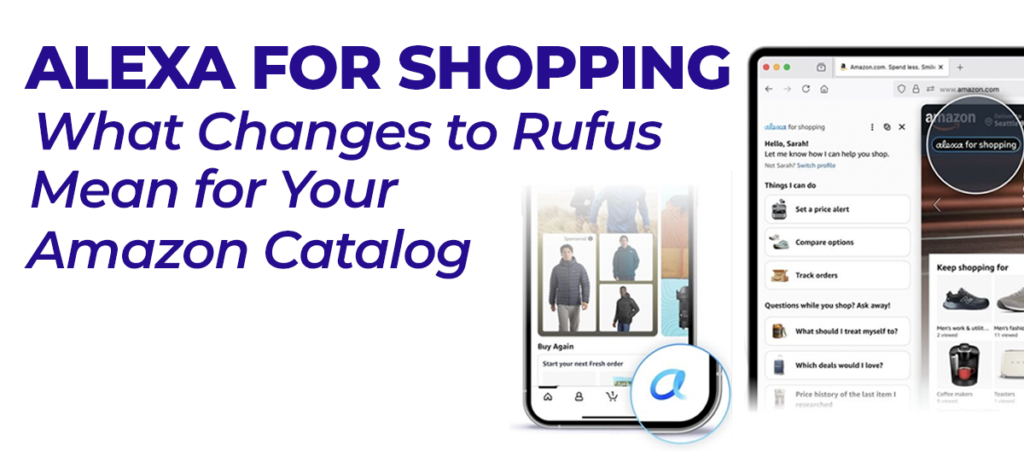
On May 13, the Rufus chatbot quietly disappeared from Amazon. No farewell announcement, no deprecation warning — just gone. In its place: Alexa for Shopping, embedded directly inside the main Amazon search bar, answering shopper questions before they ever scroll to a product page.
The headlines called it a shutdown. It wasn’t. It was an upgrade. And the implications for every brand selling on Amazon are more significant than most people realize.
The Rebrand That Wasn’t a Rebrand
When news broke that Amazon was “axing Rufus,” it was easy to read it as an admission of failure. But look at what Amazon actually said: they brought together Rufus and Alexa Plus to create Alexa for Shopping — a personalized AI shopping agent living directly inside the search experience hundreds of millions of shoppers use every day.
Rufus drove $12 billion in incremental annualized sales in 2025. That’s not a product Amazon retires. That’s a product Amazon doubles down on.
The strategic logic is straightforward. Amazon has spent years building Alexa into the fabric of the home. It’s the device in the kitchen. The one the whole family talks to. Rather than maintain two separate AI-branded products — one in the home, one in search — Amazon collapsed them into one: a single, recognizable Alexa identity, now with shopping intent baked directly into the search bar.
This is Amazon going bigger, not retreating. And it has a direct consequence for your catalog.
Your Listings Have a New Reader. Most Weren’t Written for It.
Alexa for Shopping doesn’t crawl your catalog the way keyword search does. It interprets it. The agent is looking to answer a question — “What’s the best cordless vacuum for a small apartment?” — and it surfaces the SKU it can most fully describe. If your listing leaves gaps, Alexa skips you and finds one it can answer with confidence.
According to Teikametrics data across 2,400+ brand audits, the average $50M brand leaves 8 of 12 catalog fields unoptimized for Alexa indexing. That’s not a small oversight. That’s the difference between winning the answer slot and being invisible to 300 million shoppers routing through Alexa for Shopping inside Amazon search.
Three signals decide whether your product surfaces or gets passed over:
Use-case coverage. Alexa indexes what a product does, not what it’s called. “Cordless vacuum” as a title keyword loses to a listing built around real use cases — small spaces, low clearance, 40-minute runtime. Listings optimized this way see +38% answer-slot visibility.
Attribute depth. Every empty structured attribute is a question Alexa cannot answer for the shopper. The agent surfaces SKUs it can fully describe. The average brand completes only 4 of 12 relevant fields.
Semantic A+ content. Alexa reads A+ as context, not decoration. Comparison tables, FAQ blocks, and attribute callouts feed the model directly. Image-only A+ modules — which represent 67% of A+ content across most catalogs — are invisible to the agent entirely.
The New Ranking Equation
Keyword rank isn’t going away. But it’s no longer the whole story.
The brands that win in the agentic search era are the ones that recognize two things have to be true simultaneously: your keyword SEO keeps you competitive in traditional search, and your Alexa Readiness determines whether you show up as the answer in AI-driven queries. Add them together and you get True Catalog Visibility — the metric that actually wins the answer slot.
Teikametrics data shows the gap is stark. The average ARI score across catalogs is 4 out of 12. ARI-optimized catalogs score 11 out of 12. That’s a +47% lift in catalog visibility — same SKU, same price, same reviews. The only difference is whether Alexa can read your content.
The Bigger Battle Nobody Is Talking About
Here’s the tension that makes Alexa for Shopping such a fascinating story: Amazon is competing in AI while being fundamentally constrained by its own business model.
Alexa for Shopping will always be biased toward Amazon. There’s no version of this where it recommends a better deal on Walmart or surfaces a subscription that’s cheaper direct-to-consumer. That inherent limitation is exactly the opening that ChatGPT, Claude, and Gemini are positioning to fill — a truly neutral AI agent that shops across every channel and recommends the best option, full stop.
Amazon’s answer to that challenge is its moat: Prime shipping, two-day delivery, an unmatched fulfillment network, and the sheer gravitational pull of the world’s largest product catalog. For the shopper who already knows what they want — a specific brand, a consumable they’ve ordered before — Alexa for Shopping is a natural, frictionless purchase. For the shopper doing research, looking for the best option across the market? That’s where the third-party LLMs may have an edge.
The honest question Amazon is placing a bet on is whether enough shoppers stay inside the Amazon ecosystem, trusting the convenience, that the bias doesn’t matter. Given that Prime membership and two-day delivery are genuinely hard to compete with, that’s not an unreasonable bet. But it’s still a bet.
What to Do About It Now
If your catalog wasn’t built with AI indexing in mind — and most weren’t — here’s where to start.
Fix the 12 indexed fields before anything else. Title, bullet points, backend attributes, A+ content, brand story. Alexa reads them in order. The first gap it hits is the only one that matters.
Stop optimizing for keywords in isolation. Start optimizing for use cases. Think about what shoppers are trying to do, not what they’re typing. Write catalog copy that answers the question, not just matches the term.
Rewrite image-only A+ as semantic A+. Every comparison, every value claim, every attribute needs to live in machine-readable text. If it only exists as a pixel, Alexa cannot see it.
And report Alexa Readiness to the executive team, not just keyword rankings. Keyword rank is a lagging indicator of what already happened. Alexa Readiness is the leading indicator of where Amazon revenue is heading.
Want to Go Deeper?
We covered the Rufus-to-Alexa pivot — and what it means for the future of AI-driven commerce — in a recent episode of the Teikametrics podcast. Alasdair McLean-Foreman and Cameron Yoder break down why this move makes strategic sense for Amazon, how the battle between Amazon’s shopping AI and neutral LLMs like ChatGPT and Claude is likely to play out, and why the convenience vs. trust tradeoff is the central tension every brand needs to understand.
Listen here: YouTube | Spotify
Score Your Catalog Today
Teikametrics built a free catalog scoring tool to help you see exactly where your Alexa Readiness gaps are — 45 checks across content, reviews, ad coverage, and AI discoverability, with an instant report and no sales call required.
Score your catalog at score.teikametrics.com →
The answer slot is up for grabs. The brands that understand Alexa for Shopping right now — what it reads, what it ignores, and how it ranks — are the ones who will own it.