
If you’re judging your TikTok performance in a silo, you’re probably getting it wrong.
That was the through-line of a recent conversation we had with Alasdair McLean-Foreman, Founder and CEO of Teikametrics, on our podcast Human in the Loop. The topic: the TikTok Halo — the growing (and increasingly difficult to ignore) phenomenon where TikTok content drives consumers straight to Amazon to buy. Not to TikTok Shop. Amazon.
For brands trying to make sense of where their growth is actually coming from, this is one of the most important — and most undermeasured — dynamics in commerce right now.
What Is the TikTok Halo?
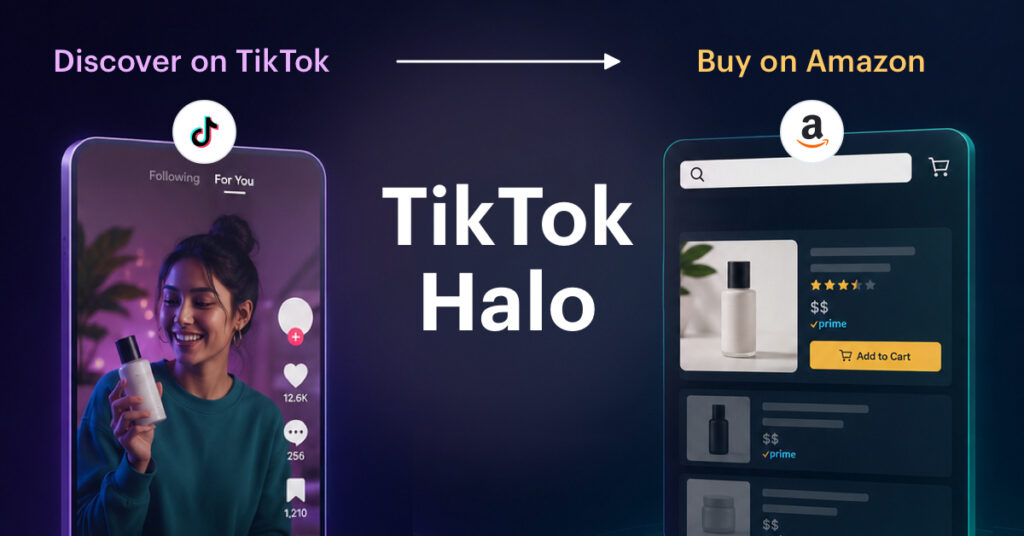
The TikTok Halo is shorthand for a simple but slippery idea: discover on TikTok, buy on Amazon Prime.
A shopper sees a creator’s video on TikTok. They don’t tap “Add to Cart.” They don’t even click the product link. They keep scrolling. Two days later, they open the Amazon app, search the brand by name, and check out in 60 seconds.
That sale shows up in your Amazon dashboard. Nothing in your TikTok analytics tells you it was TikTok that started the journey. The credit lands in the wrong column — or no column at all.
Multi-touch attribution has always been hard. But the rise of TikTok as a true discovery engine, paired with the unmatched trust and convenience of Amazon Prime, has turned the halo into one of the biggest measurement gaps in performance marketing today. Fospha has reported that roughly 40% of Amazon revenue for the brands they study is influenced by non-Amazon paid media — predominantly Meta and TikTok. Brands that don’t measure that influence aren’t being neutral. They’re choosing to under-credit a meaningful share of what their social spend is actually producing.
Why This Is Especially Painful for Larger Brands
You might assume the halo problem mostly affects DTC scrappers running affiliate-heavy plays on TikTok Shop. The opposite is increasingly true.
A lot of the larger brands we talk to — including ones now surging onto TikTok after sitting out 2024 because of the U.S. ban uncertainty — face two structural challenges that make the halo even harder to ignore:
1. They can’t (and won’t) discount their way to virality.
A lot of TikTok Shop’s flash-sale energy is driven by aggressive discounting. That’s fine if you’re a viral upstart. It’s a non-starter if you’re a $50M+ brand with carefully managed price parity across Amazon, retail, and DTC. Discounting on TikTok Shop creates channel conflict, breaks MAP, and erodes the brand equity you’ve spent years building. So large brands often choose to have a presence on TikTok without ever opening a TikTok Shop at all.
That means there’s no closed-loop conversion to measure on TikTok. The performance — if there is any — only shows up downstream. Almost always on Amazon.
2. They have less control over the creator narrative.
Alasdair shared a story from a beauty brand operator he’d just spoken to. Their TikTok program had run into a wall: a wave of creators were posting “buy this before it’s discontinued!” videos to drive urgency and affiliate commissions. The product wasn’t being discontinued. The brand had no way to stop it.
For brands in beauty, supplements, pet food, or anything where ingredient claims and brand voice matter, that loss of control isn’t a minor annoyance. It’s a real risk. You want to go viral — but you want to go viral for the right reasons.
So what do these brands do? They lean into TikTok as a top-of-funnel awareness and discovery engine, accept that they won’t measure it cleanly inside TikTok Shop, and try to figure out how to connect what’s happening on TikTok to what’s happening on Amazon. That’s the halo problem in one sentence.
The Consumer Psychology Behind the Halo
There’s a reason this pattern is so durable, and it comes down to trust.
If you ask a consumer to choose between buying on TikTok Shop or buying the same product on Amazon, Amazon usually wins on the things that matter most at the point of purchase: two-day delivery, frictionless returns, predictable customer service, and a checkout experience they’ve used a thousand times. Approximately 70% of all product-related searches still start on Amazon. The fulfillment trust is unmatched.
TikTok, on the other hand, is unmatched at the other end of the funnel. About 70% of TikTok users say they’ve discovered new brands through TikTok content. The platform’s algorithm is so good at putting the right product in front of the right person that even users who came to be entertained leave with a shopping list.
Put those two facts together and you get the halo. TikTok wins discovery. Amazon wins the transaction. The consumer doesn’t see a measurement problem — they see a workflow that works.
The caveat: this dynamic looks a little different for younger audiences, who are more comfortable transacting natively in TikTok Shop. But for the broader market — especially the audiences large brands care most about — the discover-on-TikTok-buy-on-Amazon pattern is the dominant pathway.
The Metric Trap (and How to Get Out of It)
Here’s where a lot of brands get stuck.
If you measure TikTok the way you measure Amazon ads — direct ROAS, in-platform conversions, last-click revenue — TikTok will look like a bad investment. Especially if you’re an established $10M+ Amazon brand. The numbers won’t add up, you’ll cut spend, and you’ll miss the actual return that’s showing up two clicks downstream on Amazon.
The mindset shift Alasdair pushed for on the podcast: don’t judge TikTok by Amazon’s metrics.
A few practical reframes:
- Treat TikTok as a top-of-funnel marketing channel. Closer to brand-building than to performance. Measure it the way you’d measure paid social or upper-funnel video — by reach, engagement, branded search lift, and downstream Amazon impact, not by in-platform ROAS alone.
- Watch the halo signals on Amazon. Branded search volume in Search Query Performance, detail page traffic, new-to-brand customer rates, and Amazon session lift after major TikTok pushes are all proxies for the halo at work. None of them are perfect. Together, they tell a directional story.
- Build the TikTok content engine now, even if the math doesn’t fully close yet. Whether you do it in-house, through a TikTok Shop Partner, or through an agency, the muscle takes time to build. By the time TikTok’s attribution and ad targeting catch up — and they will — the brands with established creator relationships and a content library will be miles ahead of the ones starting cold.
- Be honest about effective cost. A 15% TikTok Shop affiliate commission rarely costs 15% in practice. Once you factor in platform-funded subsidies, co-funded shipping fees, and the non-refundable nature of commissions after the settlement window, effective cost of sale on the affiliate side is often closer to 26%. That changes the unit economics conversation considerably.
What’s Coming Next
Two trends are worth watching, because they’ll shape how the halo evolves over the next 12 to 24 months.
TikTok will keep trying to close the loop inside its own ecosystem. Sponsored TikTok Shop ads, better targeting, and AI-driven campaign formats like GMV Max are all signs that TikTok wants more of the conversion to happen on-platform. That’s good news if you sell on TikTok Shop. It does not, however, change the halo math for the large brands that intentionally don’t have a TikTok Shop. For them, the attribution gap stays open.
Amazon will keep trying to look more like TikTok. Amazon has experimented with content-driven discovery feeds (the Inspire feed was killed in late 2024 because shoppers weren’t on Amazon to browse), and it’s continuing to push creator content, video, and influencer storefronts. Whether any of those efforts can compete with TikTok’s 90+ minutes of daily user attention is a different question. Probably not. The more likely outcome is a permanent multi-touchpoint world, where TikTok owns discovery, Amazon owns conversion and fulfillment, and the brands that win are the ones who treat that as a feature, not a bug.
The Takeaways
A few things to take with you:
The halo is real, and it’s bigger than your TikTok dashboard suggests. If you’re only looking at TikTok Shop revenue, you’re underestimating TikTok’s contribution to your business — sometimes dramatically.
For larger and more established brands, TikTok is not a discounting channel. It’s a discovery and brand-building channel. Don’t let early ROAS conversations kill your investment before the strategy has time to compound.
Get started now. Build the creator relationships, build the content engine, run TikTok in an experimental bucket with patient capital. The brands that wait for TikTok attribution to be perfect will be late.
And don’t measure TikTok in a silo. The whole point of the halo is that the channels work together. Your measurement should too.
Want to See the Halo in Your Own Business?
If you’re trying to understand how much of your Amazon performance is being driven by TikTok — and where the gaps in your strategy are — Teikametrics offers a free Opportunity Analysis. We’ll pull a cross-channel view of your business and walk through where the real growth levers are.
👉 Sign up here: demo.teikametrics.com
And for the full conversation with Alasdair on the TikTok Halo — including the stories from real brand operators that didn’t make it into this post — listen to the latest episode of Human in the Loop on Spotify.