

Finding the best Amazon ad optimization agency for ecommerce is less about “near me” and more about proven performance, tooling, and a fit to your goals. The right partner will align ad strategy with your catalog economics, automate the repetitive, and report with full transparency so you can scale profitably. This guide distills what to look for in 2026—from data-driven bidding and Amazon Marketing Cloud (AMC) insights to testing rigor and contract guardrails—so you can shortlist, vet, and select with confidence. If you do want local collaboration, start with capability-first criteria, then narrow by geography using directories like the Teikametrics Partner Network to find vetted agencies near you. For brands that prize ROI without complexity, platforms like Teikametrics blend retail-trained AI with hands-on experts to deliver measurable growth and radically clear reporting.
Define Your Primary Advertising Goal
Clarity on your primary objective determines the right agency model, staffing mix, and success metrics. Decide what matters most for the next two quarters, then score agencies on how directly they support that outcome.
Typical goals to prioritize:
- Lowering ACoS while protecting revenue
- Scaling TACoS efficiently by growing total sales faster than ad spend
- Driving organic rank for priority keywords and hero ASINs
- Launching new products or entering new geographies with controlled payback
- Building full-funnel awareness and remarketing audiences via DSP
Execution Vendor, Channel Specialist, Performance Optimizer, or Growth Partner? This spectrum helps match partner types to goals:
- Execution Vendors handle day-to-day PPC tasks at scale.
- Channel Specialists go deep on specific tactics like Amazon DSP.
- Performance Optimizers focus on efficiency, cost control, and margin.
- Growth Partners deliver integrated, full-funnel strategies and cross-functional guidance informed by advanced analytics like AMC and retail data Incrementum Digital’s 2026 agency guide.
Full-funnel strategy means coordinating media and creative across awareness, consideration, and purchase stages—connecting on-Amazon ads with complementary channels for cumulative lift.
Identify Essential Agency Capabilities
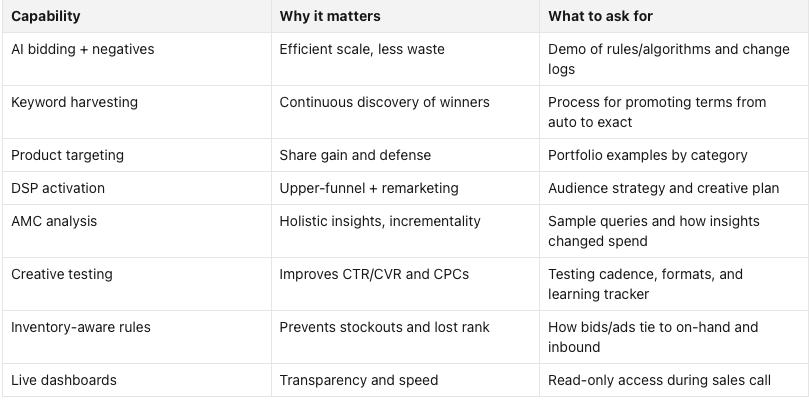
Future-proof Amazon optimization hinges on a stack of capabilities that work together—not one flashy tactic. Map your must-haves, then validate proof of execution.
Capabilities to require:
- AI-driven bidding with keyword harvesting and negative automation; examples include platforms highlighted by DesignRush’s 2026 PPC tools overview.
- ASIN-level product targeting (conquesting and defensive placements).
- Amazon DSP for upper-funnel reach and retargeting.
- Integration with AMC for privacy-safe, cross-media analytics and attribution.
- Creative testing at a defined cadence for Sponsored Brands, Sponsored Display, and Storefront modules.
- Inventory-linked automation to pause/restart ads based on stock.
- Real-time dashboards exposing search term, placement, and ASIN performance.
Amazon Marketing Cloud (AMC) is a privacy-safe analytics environment that aggregates ad and retail signals across media types to enable deeper targeting and multi-touch attribution.
Comparison checklist you can share during vetting:
Evaluate Amazon-Specific Expertise and Case Studies
Ask for recent, relevant case studies with before-and-after performance—and how strategy evolved over time.
What to request:
- ACoS, TACoS, conversion rate, CPC, and revenue deltas by campaign type.
- How AMC or DSP learnings informed budget shifts vs. simple bid changes.
- Benchmarks by category and placement; typical Amazon campaign conversion rates range 9%–15%, and winning the Buy Box accounts for 80%+ of conversions, so context matters (SalesDuo’s 2026 strategy analysis).
Definitions for quick alignment:
- ACoS (Advertising Cost of Sale) is ad spend divided by ad-attributed sales.
- TACoS (Total Advertising Cost of Sale) is ad spend divided by total sales.
Probe for decision logic. For instance, AMC path-to-conversion data prompting more upper-funnel DSP to accelerate new-to-brand acquisition, or Sponsored Display retargeting turned on after seeing a high detail-page view to purchase lag.
To see how a retail-AI approach pairs with human expertise, review examples like Teikametrics helping DIRTEA lift conversions through AI-powered bidding and creative refinement (case study).
Verify Tooling, Data Integration, and Reporting Transparency
Seamless data flows and crystal-clear reporting are non-negotiable for rigorous optimization.
Verify:
- Integrations with core tools (e.g., Helium 10, Perpetua, Quartile, Sellozo), plus Amazon Ads and Seller/Vendor APIs—validated in a live environment, not slides (DesignRush’s tools landscape).
- Compatibility with your BI stack (e.g., Looker, Tableau, Snowflake).
- Real-time dashboards with search-term-level data and update logs. Monthly PDFs alone are insufficient.
Transparent reporting means always-on dashboards showing spend, sales, conversions, search terms, ASIN performance, placements, and all bid or structural updates—not static, infrequent summaries.
Quick-reference tool snapshot:
Quick-reference tool snapshot:
Core strengths
Teikametrics
Amazon & Walmart advertising optimization, automated bidding, listing optimization, Retail-trained AI, inventory-aware bidding, full-funnel analytics, transparent dashboards (overview)
Helium 10
Keyword research
Perpetua
Automated bidding, goal-based optimization
Quartile
Rules-based PPC automation and reporting
Sellozo
PPC automation with campaign studio
Assess Testing Roadmap and Optimization Processes
Great agencies operate a scientific, documented, and repeatable testing engine.
What to see in their roadmap:
- Creative refresh cadence by format, category, and seasonality.
- Keyword harvesting and negation rules, with playbooks for promoting winning terms from auto/broad to phrase/exact.
- Dayparting logic—hourly or daily bid modifications to match conversion patterns, not vanity traffic (hybrid automation best practices).
Definitions that keep teams aligned:
- Dayparting is adjusting bids on a schedule to match when shoppers are most likely to convert.
- Keyword harvesting is continuously mining search term reports to find and prioritize converting queries.
Best-in-class performance blends automated bid engines with expert manual oversight, so strategies adapt quickly to data and market shifts.
Negotiate Clear KPIs, Contract Terms, and Exit Clauses
Protect your downside while creating room for upside.
- Set quantifiable KPIs: target ACoS/TACoS ranges, minimum conversion lift, new-to-brand share, and reporting SLAs.
- Use flexible, time-bound contracts with performance-based exit clauses. Avoid rigid, long-term commitments unless milestones are consistently met (agency contracting guidance).
- Red flags: guaranteed results, black-box reporting, lack of Amazon-specific expertise, or treating Amazon like generic paid search.
Conduct a Time-Bound Pilot with Defined Success Metrics
Start with a low-risk, high-learning engagement.
- Recommend a 4–8 week pilot with clear success metrics: ACoS reduction, ≥80% of campaign structure mapped to strategy, and 90%+ support response within one business day.
- Hold weekly or bi-weekly reviews to assess progress, knowledge transfer, and next steps.
A pilot program in Amazon advertising is a short-term, contract-limited engagement to validate agency fit, data quality, and delivery against agreed milestones before scaling.
Align Advertising Strategy with Product Listings and Inventory Signals
Ads amplify what’s already there—so ensure the foundation is solid.
- Confirm listing readiness: titles, images, bullets, A+ content, reviews, and Buy Box health before scaling spend (scaling checklist).
- Require inventory-linked automation to pause ads on low stock and resume on replenishment, protecting margins and rank (inventory-aware best practices).
- Use this simple flow: optimize listings → verify Buy Box and supply → calibrate bids/targets → scale budgets with testing → expand to DSP/AMC-informed full-funnel.
The Buy Box is the default purchase option on a product page; winning it captures the vast majority of conversions, often 80% or more in many categories.
For end-to-end control of demand and supply signals, align your ad plan with inventory forecasting and replenishment workflows (see Teikametrics’ inventory optimization approach: framework).
Frequently Asked Questions
What types of Amazon ad optimization agencies exist and which should I choose?
Amazon ad optimization agencies include Execution Vendors, Channel Specialists, Performance Optimizers, and Growth Partners. Choose based on your primary goal—maintenance, channel depth, efficiency, or full-funnel growth.
How can I verify an agency’s use of advanced tools like Amazon DSP and AMC?
Ask for case studies showing how DSP audiences and AMC analysis directly changed targeting, budgets, or creative—and request a walkthrough of an AMC query and resulting action.
What key metrics should I expect in agency reporting and performance measurement?
Expect real-time views of ACoS, TACoS, conversion rates, Buy Box wins, keyword and ASIN performance, and placement data—accessible via dashboards, not just monthly PDFs.
How do I ensure an agency’s strategy aligns with my brand’s growth stage?
Require a goal-first plan mapping tactics to your maturity—launch, scale, or efficiency—plus a testing roadmap and KPIs tied to your P&L.
What are common red flags to avoid when selecting an Amazon ad optimization partner?
Avoid guaranteed outcomes, black-box or infrequent reporting, generic paid search playbooks, and long contracts without performance-based exits.
To explore a hybrid of ARI precision and expert guidance tailored to ecommerce leaders, see how Teikametrics structures full-funnel optimization with transparent reporting: Teikametrics.com